
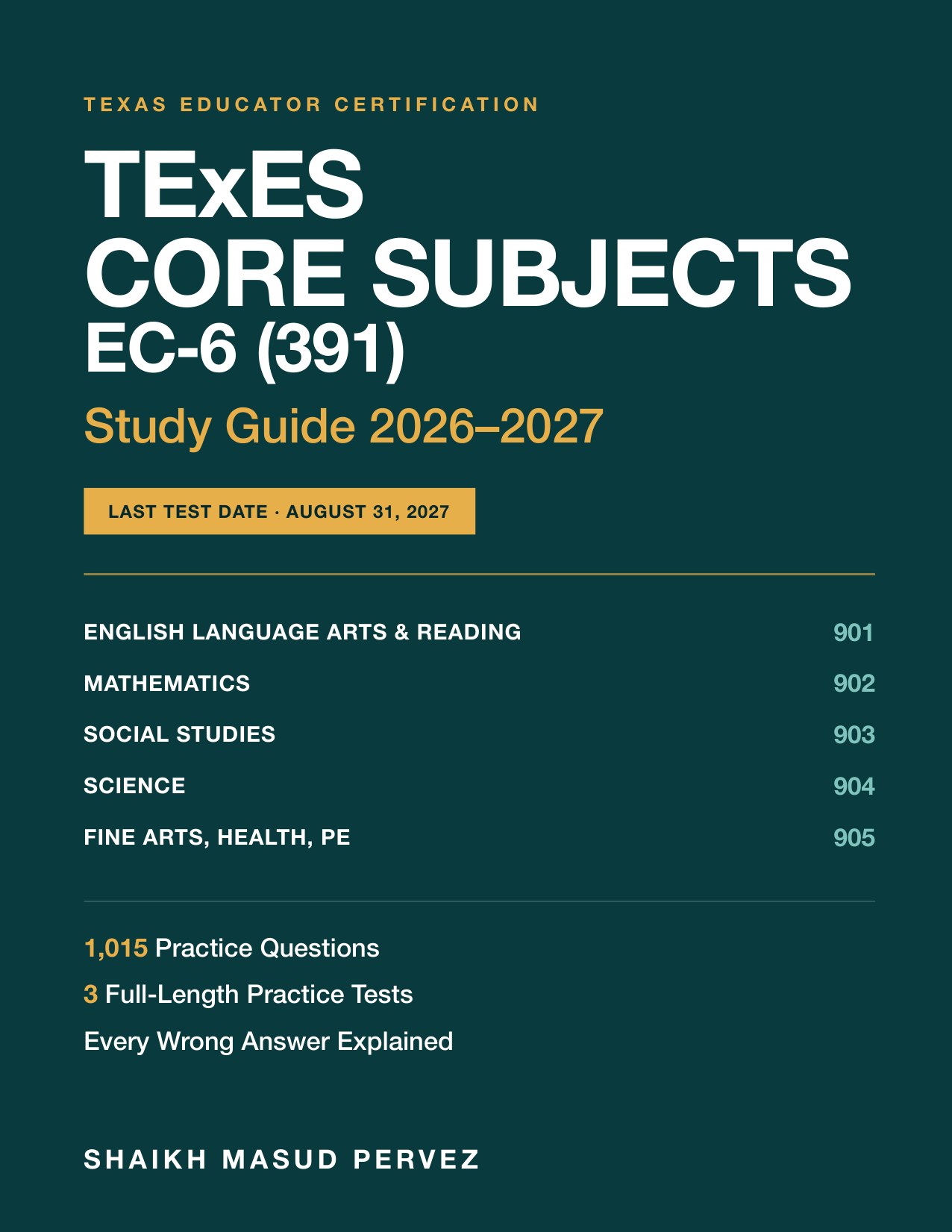
TExES Core Subjects EC-6 (391) Study Guide 2026-2027
All Five Subject Areas with 1,015 Practice Questions and Two Full-Length Practice Tests
What is inside
- 43 chapters built on the state's own 44 published competencies, in the state's own wording, so finishing a chapter means finishing a competency
- 1,015 practice questions, every one written for this book
- Three full-length practice tests — 210 questions each, in the same proportions as the real exam: 45/40/40/45/40 across the five subject exams
- An explanation for every answer, naming the specific mistake each wrong option was built on
- A competency map that turns a wrong answer into a study plan: every test answer is tagged with its competency number, and the map sends you to the chapter that covers it
- Two study plans — eight weeks, and four weeks when that is all you have
Five subject exams. Five separate passing scores. No averaging.
A 265 in mathematics does not carry a 232 in science. Each of the five subject exams inside the 391 is scored on its own scale, and every one needs a 240. Most candidates learn this too late, after spending their study time on the areas they already liked.
If you are strong in four areas and shaky in one, your weak area is your entire exam. Science and the 905 exam together carry 85 of the 210 questions, and they are the two most candidates leave until the last weekend.
What is inside
Two question formats most guides never mention
Almost every item on the 391 is a single question with four choices. Two exceptions appear in the state's own sample questions, and a candidate who has never seen them loses time working out what is being asked.
Clustered questions present one passage, work sample or data set and ask two or more questions from it. Select all that apply items ask for every correct option rather than the single best one, and may offer five choices instead of four. This book explains both and works through a full example of each, because the first time you meet one should not be on test day.
Science gets thirteen chapters
The science subtest carries eighteen competencies, more than any other on this test: physics, chemistry, biology, earth and space science, laboratory safety and science teaching methods. It gets the most room in this book for that reason.
Why the explanations are different