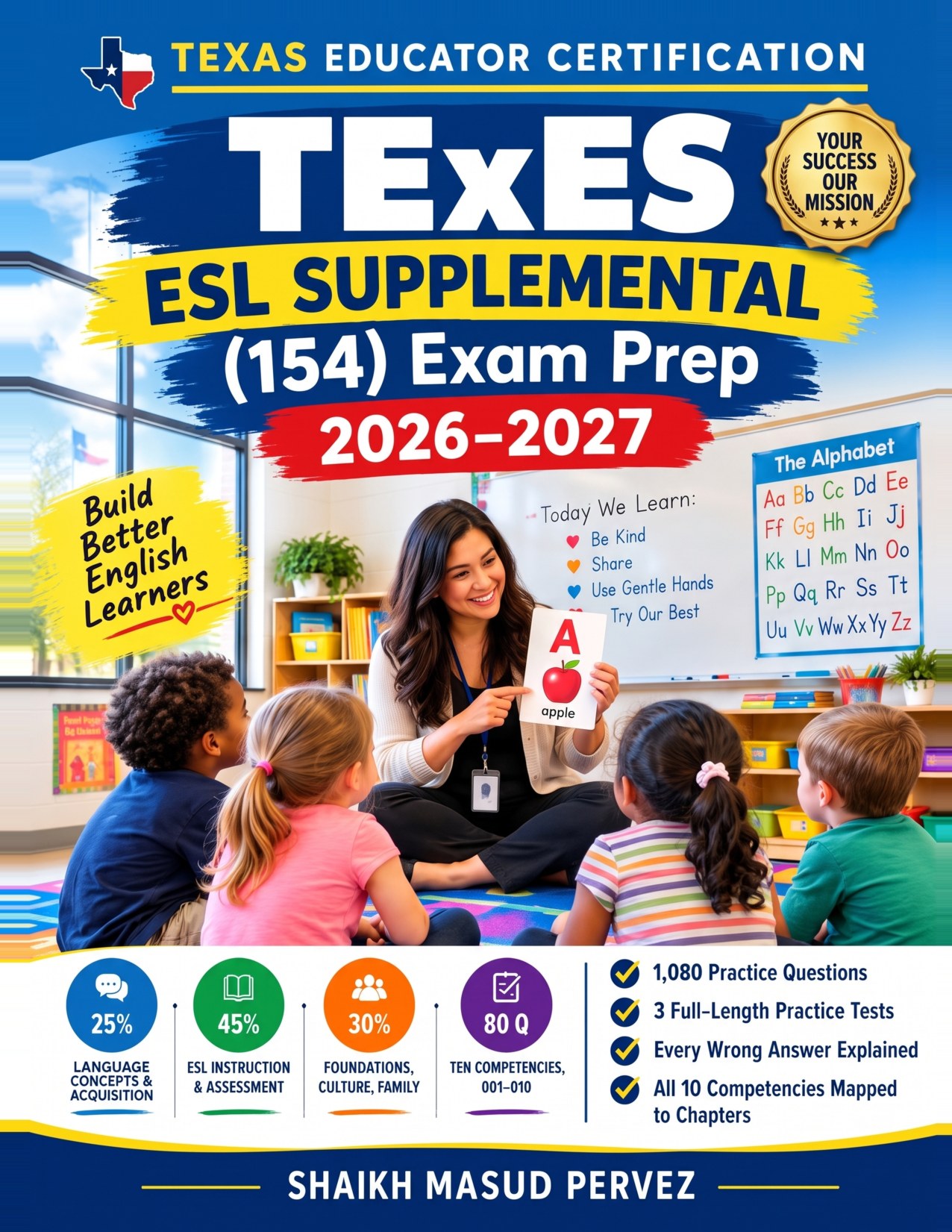
TExES ESL Supplemental (154) Exam Prep 2026-2027
Study Guide with 1,080 Practice Questions and Two Full-Length Practice Tests
THE STANDARDS CHANGED IN 2026. THE EXAM DID NOT.
Texas adopted new English Language Proficiency Standards for classrooms beginning in 2026–2027 — five proficiency levels where the old standards had four. The 154 framework was not rewritten around them. A guide built on the new standards teaches you the wrong answer on test day; a guide that ignores them leaves you unready for your own classroom. This one draws the line in writing and tells you which side each question is on.
BUILT ON THE STATE'S FRAMEWORK, COMPETENCY BY COMPETENCY
Fifty-six chapters follow the state's ten competencies in the state's own order, and all fifty descriptive statements are answered somewhere you can find them. Finish a chapter and you have finished a piece of the framework.
WHAT IS INSIDE
- 1,080 practice questions, every one written for this book
- Three full-length practice tests, 80 questions each, built at the published 25/45/30 domain weights — the same proportions as the real exam
- Every question explains all four options: why the right one is right, and what each wrong one was written to catch
- Both official question formats, single and clustered, with a clustered set in every practice test
- A competency map that turns a wrong answer into a study plan — every test answer is tagged, and the map sends you to the chapter that covers it
- 376 pages, 8.5 x 11, with room to write
THE PARTS MOST GUIDES GET THIN
The ELPS, the language proficiency assessment committee, and Texas rule are quoted from the code rather than remembered: the four-week identification deadline, the ten-day notice, the twenty-student threshold, the exact wording of both home language survey questions, and the full reclassification criteria — a TELPAS composite of advanced high, satisfactory performance on the state reading assessment in English, and the teacher evaluation on the state's own form.
Domain I is treated as the quarter of the exam it actually is. You will be able to say whether an error is phonological, morphological, syntactic, semantic, or pragmatic — and say it quickly, because a great many questions turn on nothing else.
WRITTEN FOR THE WAY THIS EXAM THINKS