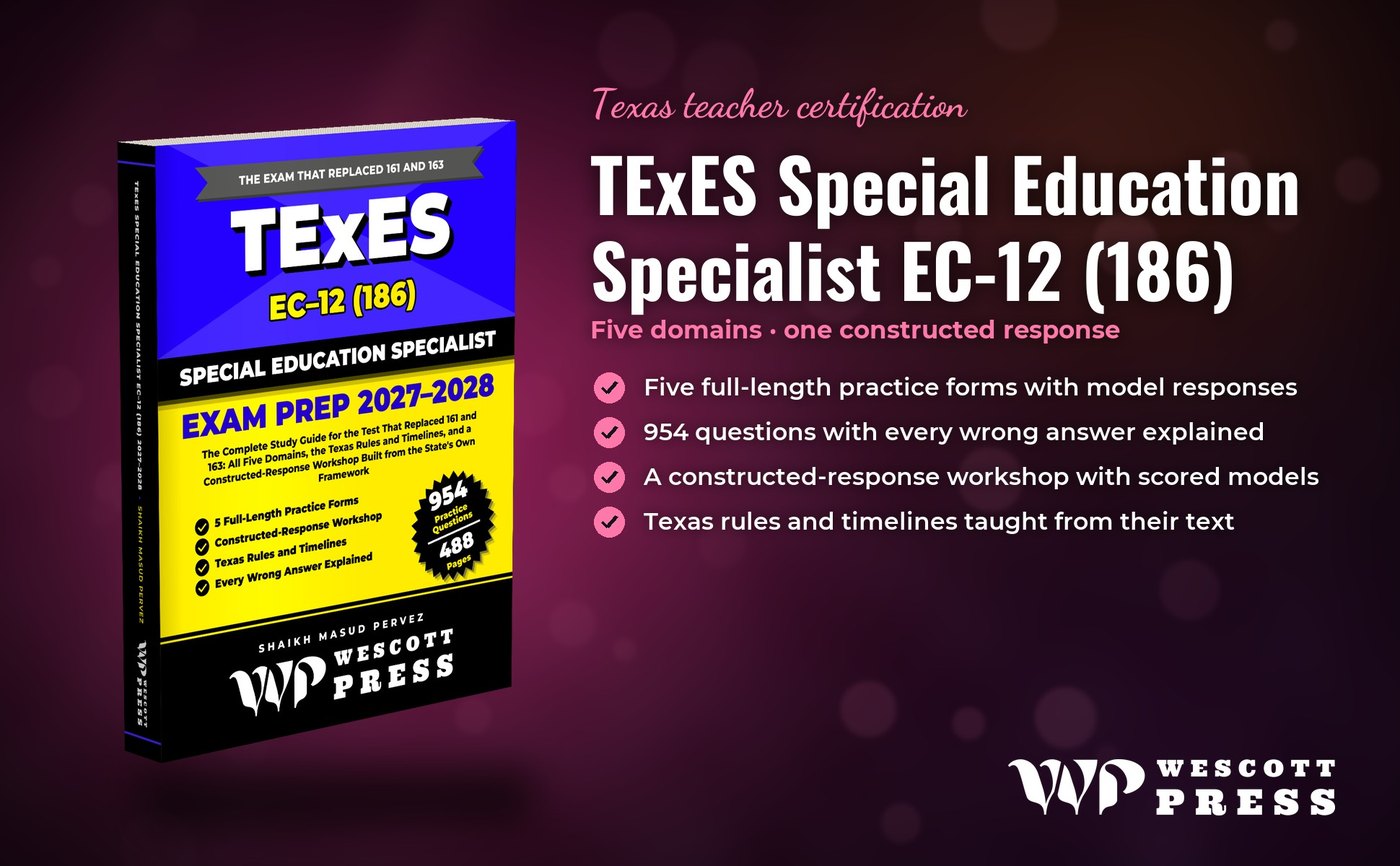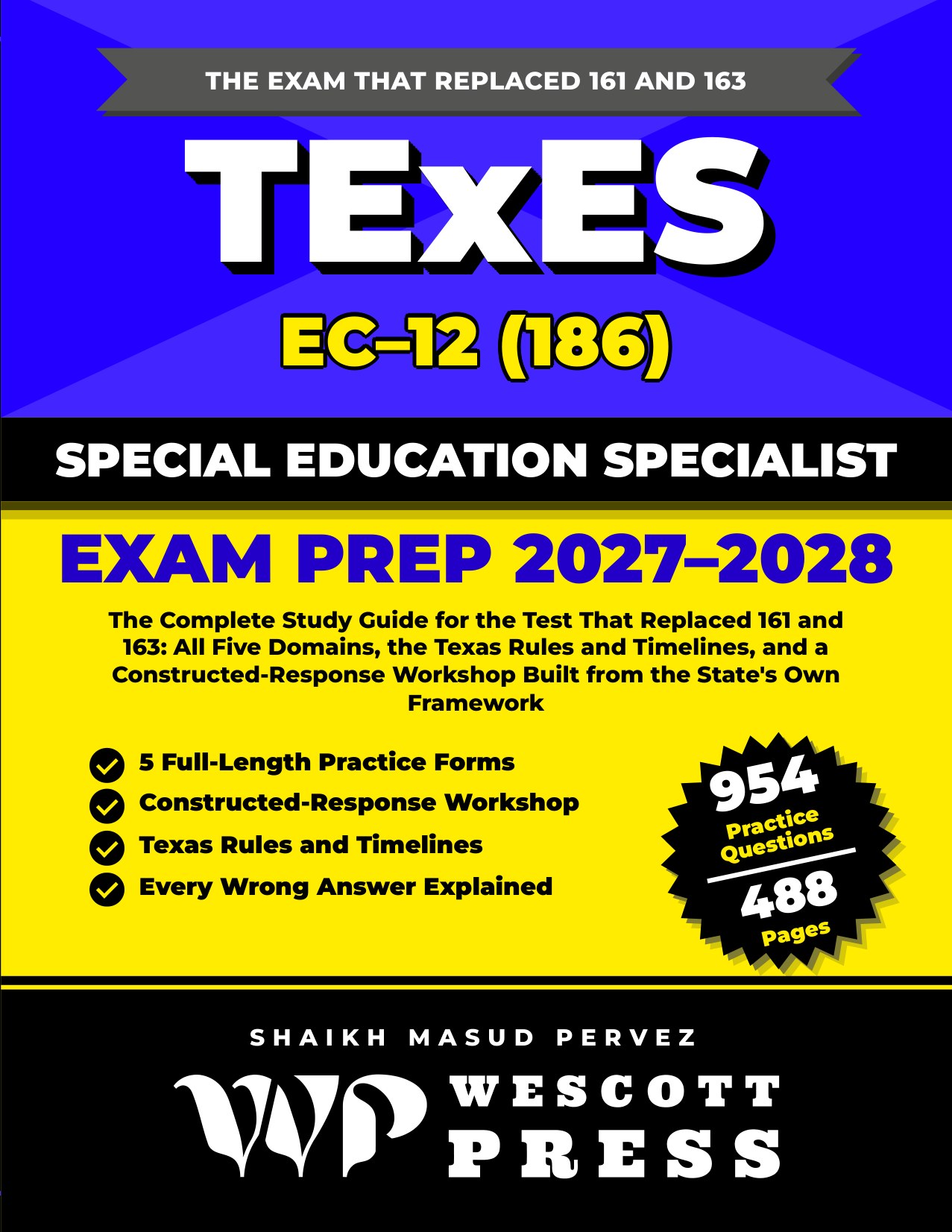
TExES Special Education Specialist EC-12 (186) Exam Prep 2027-2028
The Complete Study Guide for the Test That Replaced 161 and 163: All Five Domains, the Texas Rules and Timelines, and a Constructed-Response Workshop Built from the State's Own Framework
What is inside
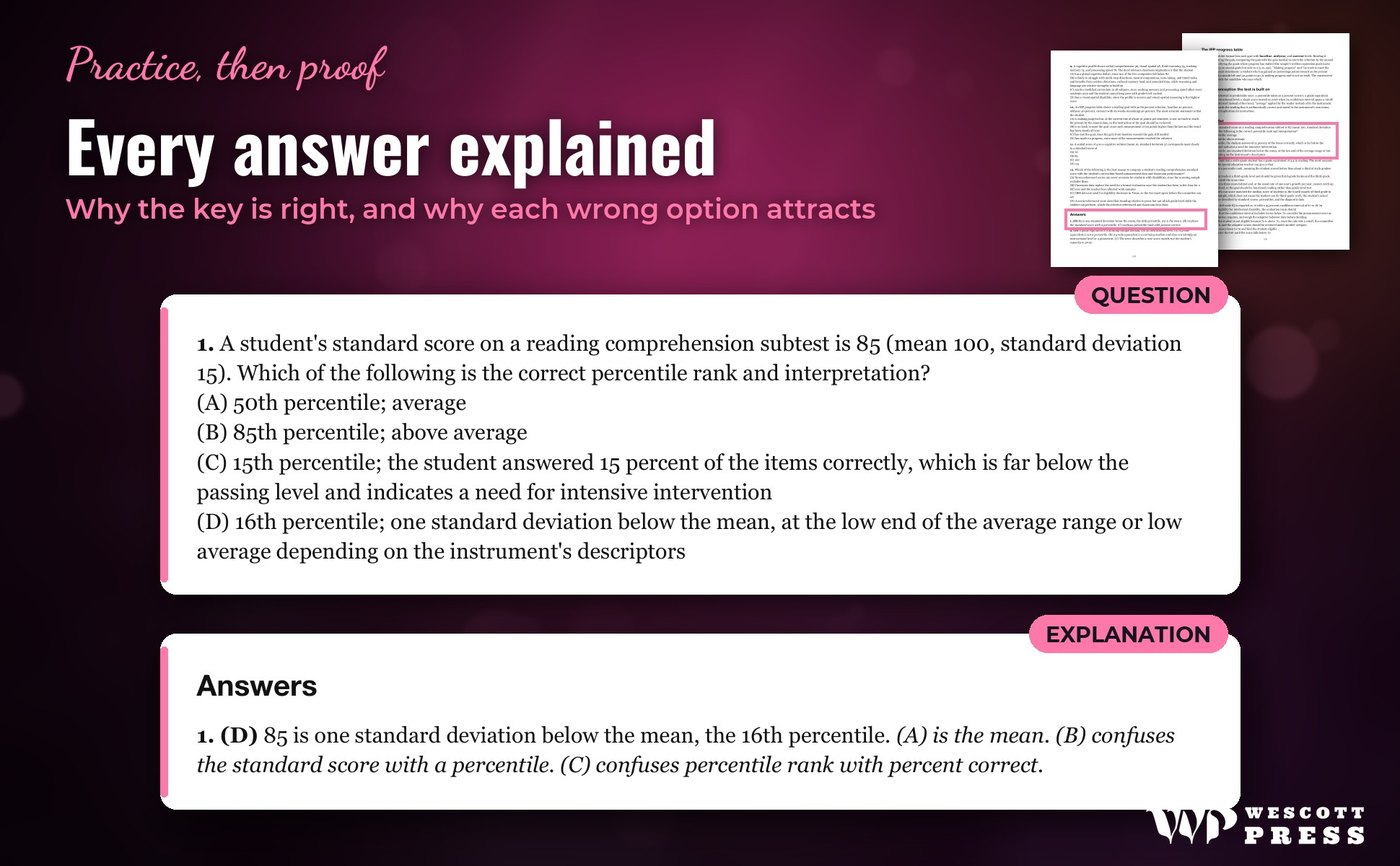
- 954 practice questions in the exam's scenario format, every wrong option explained
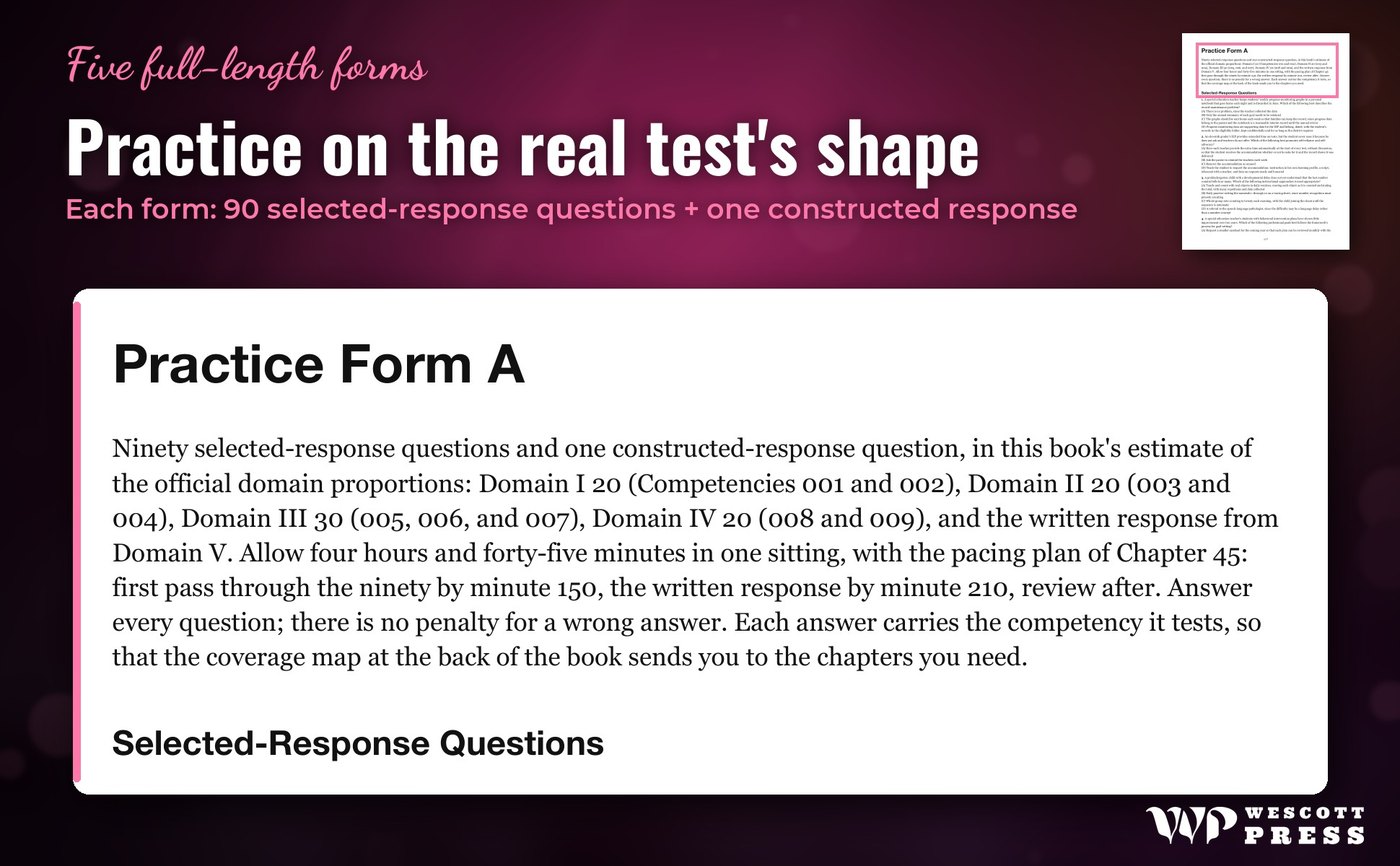
- Five full-length practice forms: 90 selected-response questions and one constructed response each, with a scored model response
- A constructed-response workshop: three original five-exhibit cases with model responses at score points 4, 3, and 2, and the official rubric explained
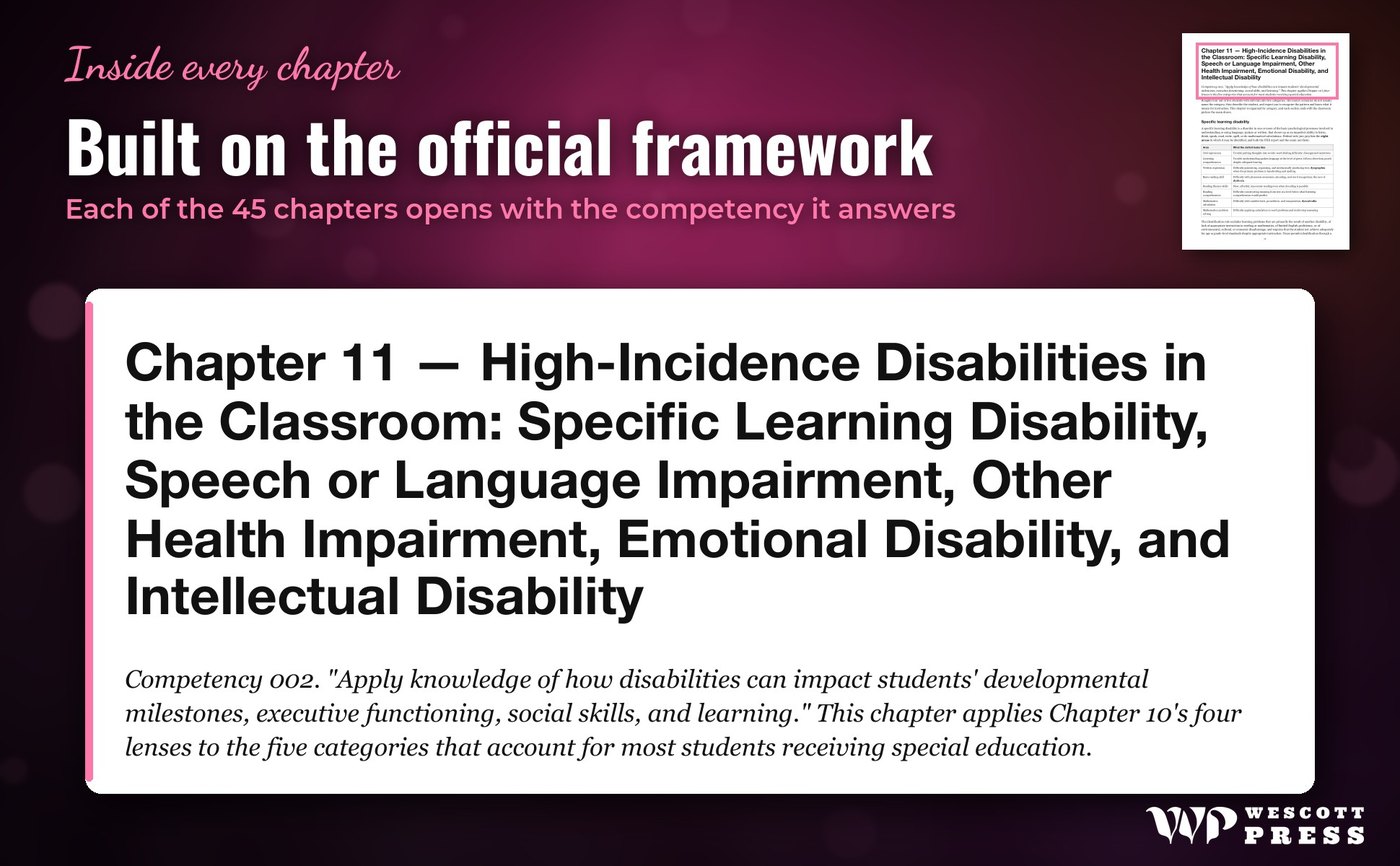
- 45 chapters written to the ten competencies, each opening with the descriptive statements it answers
- The Texas rules and timelines: ARD membership, the 15-, 45-, and 30-day clocks, the 20-day transfer rule, transfer of rights at 18, the three diploma routes, discipline and restraint
- The exam's own rules: the first-attempt fee waiver, the 30-day retake, the five-attempt limit, and what the retirement of the 161 means
- Numbers-and-timelines quick reference, consent-and-decision table, coverage map, score tracker, wrong-answer log, and acronym glossary
- Test-day plan with an hour protected for the written response, plus six-week and two-week study plans
Since September 2025 one exam has certified every special education teacher in Texas. This book was written to its framework, not to the retired 161.
The Special Education Specialist EC-12 (186) replaced the 161 and the 163, and since September 1, 2026 a 161 score cannot be used for a certificate. The 186 is 90 selected-response questions and one constructed response in a single 4-hour-45-minute session, across five domains, and the written response alone is worth about a fifth of the score. It is not a generic special education test: it names the ARD committee, the Full and Individual Initial Evaluation, the TEKS, the Prekindergarten Guidelines, and Rule 89.1070 on graduation, and a candidate who knows only the federal law misses the Texas layer.
Built from the state's own framework
Every one of the 45 chapters opens by quoting the descriptive statements it answers, so you can see which of the framework's requirements you are covering. Every practice question is a scenario in the exam's register, with four options, one best answer, and every wrong option explained by the reason it fails. The Texas rules are taught from their current text, including the 2024 eligibility change that retired the noncategorical early childhood description in favor of developmental delay, a change most study materials have not caught up with.
What is inside
- 954 practice questions, every wrong answer explained
- Five full-length practice forms at the exam's format: 90 selected-response questions and one constructed response each, with a scored model response
- A constructed-response workshop: three original five-exhibit cases with model responses at score points 4, 3, and 2, the official rubric explained, and a timed 400-600-word method
- 45 chapters written to the ten competencies, from the Prekindergarten Guidelines to postsecondary transition, with the accommodation-or-modification line, explicit and systematic instruction, UDL, assistive technology, PBIS, FBAs and BIPs, co-teaching, and advocacy
- The Texas rules and timelines: ARD membership and agenda, the 15-, 45-, and 30-day clocks, the 20-day transfer rule, transition at 14, transfer of rights at 18, the three diploma routes, discipline, restraint and time-out, and the duty to report
- The exam's own rules: the first-attempt fee waiver, the 30-day retake, the five-attempt limit, and what the retirement of the 161 means for you
- Numbers-and-timelines quick reference, consent-and-decision table, coverage map, answer key at a glance, score tracker, wrong-answer log, answer sheet, and acronym glossary
- A test-day plan with pacing checkpoints and an hour protected for the written response, plus six-week and two-week study plans
Why the written response gets a whole workshop
The constructed response is the one question a candidate cannot pass by recognition. The published rationales for the sample responses are precise about what separates a 4 from a 3: citing specific data from the exhibits, building one recommendation on the identified strength, describing the teacher's role, and monitoring with a concrete measure tied to the IEP goals. The workshop shows that difference on three complete cases, and each practice form ends with a fourth.
Not affiliated with or endorsed by the Texas Education Agency, the State Board for Educator Certification, or Pearson. TExES is a mark of the Texas Education Agency, which does not sponsor or endorse this product. Exam details and Texas rules were checked in September 2026; confirm current details on the official testing website before you register.